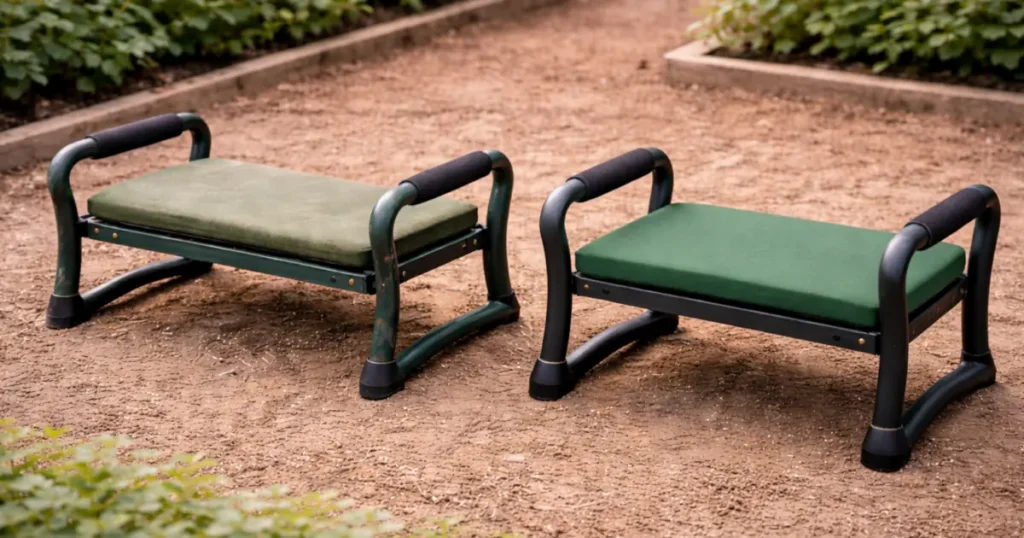
This guide covers how long do garden kneelers last — what to look for, which models perform best, and how to match the right option to your routine. Garden kneeler lifespan is driven more by use intensity and terrain than by price label alone. A higher-cost model can wear quickly under daily hard-surface use, while a mid-tier model can last multiple seasons under moderate soft-soil routines. Price tier changes the timeline, but it does not override workload.
The wear pattern is usually predictable. Foam compresses first, hinges loosen second, coatings degrade gradually, and then structural feel changes enough to trigger replacement decisions. Buyers and owners who understand this sequence make better purchase and maintenance choices.
This guide breaks lifespan by use pattern and identifies repair-versus-replace signals before major failure.
How Long Do Garden Kneelers Last: What Determines Lifespan
Four variables control most kneeler lifespan outcomes.
Foam compression rate is the first variable. Repeated load on hard surfaces accelerates thickness loss. As foam loses rebound, contact pressure rises and comfort drops. This often becomes noticeable before any frame issue appears.
Hinge fatigue is the second variable. Folding models accumulate wear at pins, lock interfaces, and joint surfaces. Daily fold cycles increase tolerance drift faster than occasional use. Early signs include slight play, uneven lock feel, and minor side movement.
Coating wear is the third variable. Painted or powder-coated steel frames degrade at different speeds depending on surface quality and storage conditions. Chips at high-contact points can expose metal and increase corrosion risk.
Terrain exposure is the fourth variable. Hard surfaces increase foam stress. Soft uneven ground increases side loading at frame legs and hinges. Both conditions are manageable, but they shorten lifespan compared with moderate mixed use on stable soil. Storage environment interacts with all four variables. A kneeler used lightly but stored wet can age faster than a heavily used unit stored dry and clean.
Lifespan by Use Pattern
| Use Pattern | Expected Foam Life | Expected Frame Life | Notes |
|---|---|---|---|
| Daily hard surface | ~6–12 months | ~1.5–3 years | Fastest compression and hinge stress pattern |
| Daily soft surface | ~12–18 months | ~2–4 years | Lower contact shock, still high cycle count |
| 2–3x per week mixed | ~1–2 years | ~3–5 years | Typical home-use baseline for mid-tier models |
| Occasional (weekly or less) | ~2–3 years | ~4–6 years | Storage and moisture control drive outcomes |
These ranges are practical estimates, not fixed guarantees. Model quality, user weight, and transition style can shift outcomes significantly.
Signs a Kneeler Is Wearing Out
Visible foam compression is the most common first signal. If pad thickness has reduced noticeably at knee contact zones, cushioning performance has already dropped.
Bottom-out sensation is a stronger signal. When users feel hard contact through foam during normal kneeling, effective pad life is near end regardless of visual condition.
Hinge play is the next major signal. Slight movement can be normal. Increasing side-to-side motion during push-off usually indicates wear progression that should be monitored closely.
Structural flex under routine load is a later signal. If the frame feels less predictable during normal rise movement than it did previously, long-term stability has likely declined.
Coating failure at stress joints is the corrosion signal. Rust at hinge and weld areas should trigger closer inspection and potential replacement planning. A practical behavior signal is confidence loss. If users avoid full push-off on handles because the frame feels uncertain, functional lifespan is already declining.
How to Extend Kneeler Life
Regular cleaning extends both foam and hinge life. Mud and grit in hinge areas act as abrasive material and accelerate wear.
Dry storage is critical, especially for painted steel frames. Moisture retained in folded joints increases corrosion risk and shortens hardware life.
Pad replacement availability should be treated as a buying spec, not an afterthought. Models with accessible replacement pads can extend useful frame life substantially.
Usage rotation also helps. Using a secondary pad on concrete or rotating kneeler use across tasks can reduce concentrated foam wear.
Monthly hinge checks are practical in frequent-use routines. Early correction of pin looseness can delay larger stability decline. Users can also rotate task exposure. Reserving one kneeler for hardscape and one for soft-ground work often extends foam life in both tools.
What Most Buyers Overlook
Most buyers evaluate kneelers after one or two sessions. Lifespan divergence rarely appears that early. Compression and hinge tolerance changes usually emerge after sustained cycle counts in month two and beyond.
Another overlooked factor is replacement economics. A kneeler does not need catastrophic failure to become functionally worn out. Performance decline can make replacement rational before breakage, especially for users with joint sensitivity.
The final blind spot is maintenance rhythm. Infrequent cleaning and damp storage can shorten lifespan more than buyers expect, even in higher-tier models. Replacement pad availability is another often-missed variable. Buyers who can replace pads extend frame value and reduce whole-tool replacement frequency.
Realistic Expectations
No kneeler lasts indefinitely under regular load. Foam and hinge systems are consumable components in repetitive movement tools.
Higher-cost models usually extend useful life through slower degradation, not immunity to wear. Under heavy hard-surface routines, replacement planning should still assume periodic pad and eventually frame turnover.
Owners who treat lifespan as a managed cycle usually get better value than owners who wait for sudden failure.
Quick Decision Guide
- Daily hard-surface routine → expect faster foam replacement and earlier hinge wear
- Mixed routine 2–3x weekly → mid-tier models usually deliver practical multi-season life
- Frame still stable but foam failing → replace pad if compatible before full replacement
- Hinge play increasing under normal load → inspect early and plan replacement if progression continues
- Full framework → garden kneeler buying guide
- Replacement timing detail → when to replace your garden kneeler
- Price-to-lifespan context → garden kneeler price guide
For garden tool longevity guidance, see the Royal Horticultural Society.