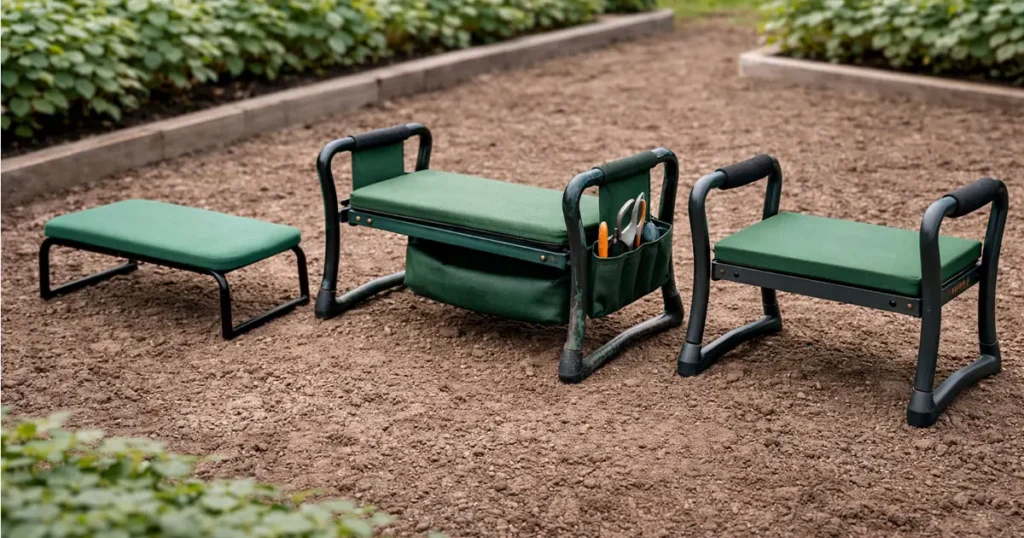
This guide covers garden kneeler price guide — what to look for, which models perform best, and how to match the right option to your routine. Garden kneeler prices span a wide range, from under $20 to above $90. The price spread reflects real differences in frame construction, foam behavior, and long-term durability, but only in certain tiers. Buyers with fixed budgets need realistic expectations before choosing.
The most useful way to read this category is by trade-off mapping. Lower tiers provide basic function and shorter durability timelines. Mid tiers improve structural consistency. Upper tiers improve lifecycle behavior and carry convenience in specific use patterns.
This guide maps each budget range to practical outcomes so buyers can choose by workload instead of marketing signals.
Garden Kneeler Price Guide: Under $25 — Budget Tier
This range usually delivers basic cushioning and minimal frame margin. Typical capacity claims are around 200–250 lbs. Frame materials are often thinner-gauge steel with standard hinges and basic paint finishes.
Common failure modes include faster foam compression, earlier hinge play, and lower handle rigidity under asymmetric push-off. None of these issues necessarily appear immediately. They usually emerge under regular use.
This tier suits occasional gardeners using soft soil and short sessions. It is less suitable for daily hard-surface use, heavier users, or transition-sensitive users. Buyers in this range should prioritize realistic workload matching over feature count. Low-cost options can perform well when use pattern is light and predictable.
$25–45 — Mid-Budget Tier
This range usually improves hinge consistency, frame feel, and foam retention relative to budget products. Capacity often rises toward 300 lbs in stronger models.
The practical gain is better stability under repeated kneel-stand cycles and slower comfort decline through a season. Coating quality can still vary, but structural behavior is usually more reliable than under-$25 options.
This tier suits regular home gardeners with mixed surfaces and moderate session frequency. It is often the first range where buyers feel predictable daily performance. This is also the range where review quality improves because more users keep the product long enough to report seasonal wear behavior.
$45–65 — Mid-Premium Tier
This range often delivers the most meaningful quality jump for many buyers. Typical improvements include stronger hinge behavior, better foam density retention, and broader availability of 300+ lb capacity designs.
Model selection is wider in this band, allowing buyers to prioritize either portability or frame rigidity without dropping to low-quality alternatives. Transition confidence and foam timeline are usually stronger than lower tiers.
This tier suits frequent users, mixed-surface users, and buyers needing better long-term behavior without moving into top pricing. Many buyers who initially target budget models end up here after first replacement. This tier often reduces replacement frequency enough to offset higher initial spend.
$65+ — Premium Tier
Premium tier usually adds better materials and slower wear progression rather than radically different functionality. Common upgrades include aluminum frame options, improved finish quality, and denser foam systems with better retention under repeated load.
Capacity often remains strong, but premium does not always mean highest capacity. Some premium models optimize for lower weight and corrosion tolerance instead.
This tier suits buyers with daily routines, higher use intensity, difficult terrain exposure, or long ownership horizons where slower degradation matters. It also suits buyers with strict portability needs, because several aluminum options appear in this range and reduce daily carry fatigue.
Where the Value Curve Peaks
For most buyers, practical value peaks around $40–60. This range usually captures most structural and foam improvements without the strongest premium markup.
The jump from $20 to $45 is often larger than the jump from $55 to $75 in everyday experience. Buyers in regular home-use patterns often get the best balance of cost and durability in this middle band.
Premium still has clear use cases, but not every workload benefits enough to justify the extra spend. For many households, this is the practical decision rule: buy at the highest tier where projected use intensity can actually consume the additional durability.
What Most Buyers Overlook
Price volatility can distort decisions. A model in one tier may temporarily shift tiers during promotions. Buyers should compare current prices, not historical assumptions.
Review timing is also critical. First-week ratings are poor durability indicators. Foam and hinge divergence usually appears after repeated use over months.
The third blind spot is terrain mismatch. Hard-surface routines accelerate wear in all tiers. Buyers should budget by workload severity, not only by purchase comfort. A fourth blind spot is shared use. One kneeler used by multiple household members usually experiences higher cycle counts and faster wear than single-user assumptions suggest. Another blind spot is accessory cost creep. Buyers often purchase add-ons after selecting a low-tier kneeler, then spend enough on pads and pouches to exceed a stronger mid-tier model. Capacity margin is also frequently ignored at lower price points. Buyers near rated limits often experience reduced confidence long before structural failure, which can shorten practical ownership.
Realistic Expectations
No tier eliminates wear. All kneelers are subject to foam compression and hinge fatigue over time. Higher tiers usually slow this process rather than removing it.
Budget tiers can work well in light use. Mid tiers usually provide the strongest value density. Premium tiers are best for high-demand routines where durability timeline has direct practical value.
The useful outcome is realistic fit between budget and workload. Price is therefore a tool-selection variable, not a quality guarantee. Better decisions come from matching tier behavior to real use frequency and surface exposure. Buyers should also expect periodic reassessment. A kneeler that fits one season may become inadequate when task volume, terrain, or user needs change. Planned replacement cycles are often cheaper than reactive emergency replacements during peak gardening months.
Quick Decision Guide
- Under $25 and occasional soft-soil use → basic models can be sufficient
- $25–45 and regular mixed use → practical baseline for many households
- $45–65 and frequent use → strongest value-to-durability range
- $65+ and high-demand routine → premium construction often justified
- Full framework → garden kneeler buying guide
- Tier shortlist → best garden kneelers
- Tier comparison context → budget vs premium garden kneeler
For general gardening equipment advice, see the Royal Horticultural Society.