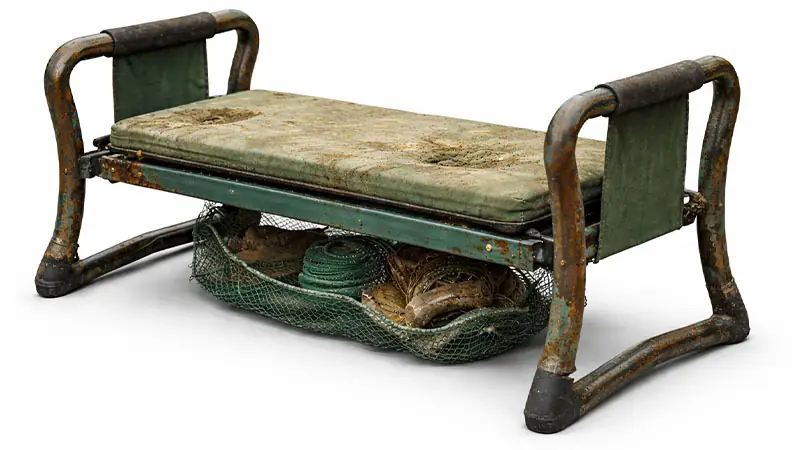
This guide covers when to replace garden kneeler — what to look for, which models perform best, and how to match the right option to your routine. Most kneelers are replaced after obvious failure. That replacement pattern is reactive and often late. A better approach is performance-based replacement before stability and cushioning decline enough to affect control.
Gradual decline is common in this category. Foam loses thickness, hinges develop play, and lock confidence drops over time. None of these changes are dramatic on day one. Combined, they can reduce session quality and increase transition risk.
This guide defines practical replacement signals and benchmarks for repair versus replacement decisions.
When To Replace Garden Kneeler: Foam Replacement Signals
Visible compression at main contact zones is the first signal. If pad thickness is clearly reduced where knees load repeatedly, support has already declined.
Bottom-out sensation is stronger evidence. When users feel hard contact through foam during normal kneeling, effective cushioning life is near end.
Uneven compression also matters. One side collapsing faster than the other can alter posture and increase asymmetrical loading during transitions.
A practical check is comparing current pad thickness to original specification or to an unused replacement pad. Large reduction indicates replacement is due even if frame remains stable. Surface-specific wear patterns should also be monitored. If one side of the pad degrades faster because of habitual positioning, replacement may be needed even before average thickness looks severe.
Frame Replacement Signals
Hinge play under normal load is the first frame warning. Slight movement is common in folding systems. Increasing side movement during push-off indicates wear progression.
Frame flex during routine rise is the second warning. If rails feel less predictable than earlier in ownership, structural confidence has declined.
Rust at stress joints is the third warning, especially near hinges and weld intersections. Surface rust alone can be manageable. Rust combined with movement and coating loss at load points is a stronger replacement signal.
Lock mechanism degradation is the fourth warning. Incomplete engagement, uneven lock feel, or accidental partial collapse behavior should trigger immediate inspection and likely replacement planning. Audible cues can be useful here. New clicking, scraping, or metallic grinding during fold cycles often indicates wear progression at contact points.
When Repair Is Worth It
Repair is usually worth it when degradation is localized and frame integrity remains strong. Common examples include pad-only wear where compatible replacement pads are available.
Minor hinge service can also be worthwhile if play is small and parts are accessible. Cost-benefit should be practical. If repair cost approaches replacement of a better-tier model, replacement is usually the stronger decision.
Not all issues are repairable. Structural flex at primary rails, severe joint corrosion, and unreliable lock behavior often indicate end-of-life for safe use.
Repair works best as early intervention. Waiting until multiple failure points accumulate usually lowers repair value. Repair viability also depends on part access. If replacement pads or hinge components are unavailable, replacement often becomes the only practical option.
Use-Pattern Replacement Benchmarks
Daily hard-surface use often drives foam replacement in 6–12 months and frame reassessment in about 1.5–3 years, depending on load profile.
Daily soft-surface use usually extends foam life toward 12–18 months and frame life toward 2–4 years.
Mixed use at 2–3 sessions per week commonly supports about 1–2 years for foam and 3–5 years for frame systems.
Occasional weekly use can extend both timelines significantly, often beyond these ranges with good storage and maintenance.
These are planning benchmarks, not fixed expiry points. Actual replacement timing should follow performance signals. Users with higher body weight or aggressive push-off style may move through these benchmarks faster than average estimates.
What Most Buyers Overlook
Gradual decline is easy to normalize. Users adapt to less cushion, looser hinges, and slower transitions without noticing cumulative change.
Declining control often appears before obvious breakage. This is especially relevant for users relying on handle support during rise. Reduced frame predictability increases transition risk even when the kneeler still appears functional.
Performance tracking is useful. Simple monthly checks of pad thickness, hinge play, and lock engagement can reveal decline earlier. This process is quick and repeatable. A short checklist after cleaning can prevent sudden usability decline during critical tasks.
Realistic Expectations
Garden kneelers are consumable mechanical tools. Foam and moving joints are expected to wear under repeated load.
The goal is not indefinite service. The goal is stable, predictable function through each ownership phase. Replacing before major instability appears usually improves comfort and control.
Owners who treat kneelers as maintain-and-replace equipment typically get better outcomes than owners waiting for abrupt failure. Most replacement decisions are not urgent if monitored early. Planned replacement usually costs less than emergency replacement during peak season.
Quick Decision Guide
- Foam feels flat or hard contact appears → replace pad if compatible
- Hinge play increases under normal push-off → inspect and plan replacement if progression continues
- Lock engagement feels unreliable → stop using until resolved
- Rust and flex appear together at stress joints → replace frame
- Full framework → garden kneeler buying guide
- Lifespan context → how long do garden kneelers last
- Product options → best garden kneelers
For garden tool guidance, see the Royal Horticultural Society.