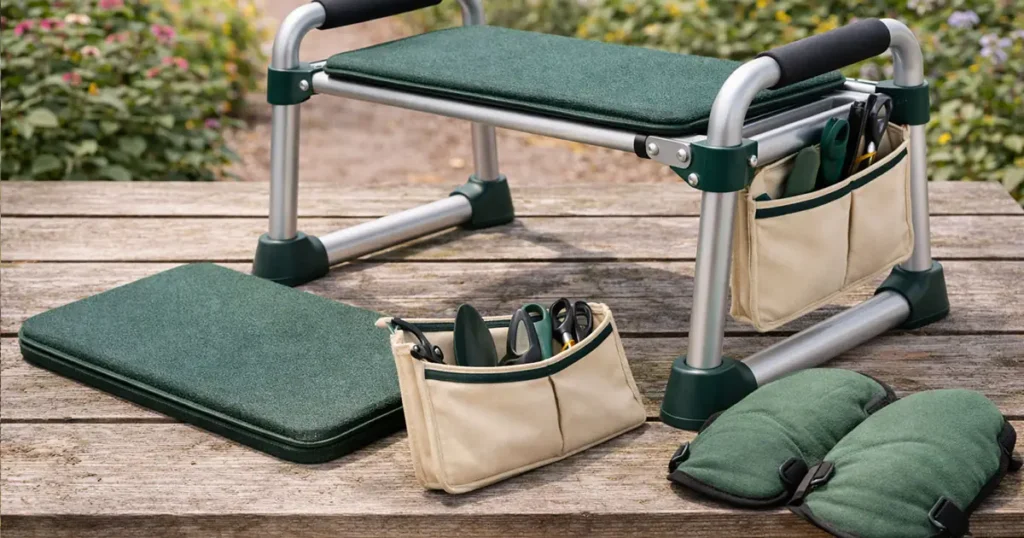
This guide covers garden kneeler accessories — what to look for, which models perform best, and how to match the right option to your routine. Most kneeler accessories fall into two groups. The first group improves real session quality through better pressure control, storage workflow, or moisture handling. The second group adds cost and clutter without solving a meaningful limitation.
Buyers often purchase accessories at the same time as the kneeler without evaluating compatibility or true use-case fit. That leads to stacked add-ons with low practical value.
This guide evaluates accessory categories by measurable contribution to durability, comfort continuity, and movement efficiency.
Garden Kneeler Accessories: Replacement Foam Pads
Replacement foam pads are one of the most useful accessories when compatible options are available. In high-use routines, foam usually degrades before frame integrity. Replacing a worn pad can restore practical support without replacing the entire kneeler.
Useful replacement pads need correct dimensions, secure attachment method, and appropriate density for terrain type. Generic pads that do not match frame profile often shift during use and reduce stability.
Compatibility is the main risk. Many kneelers do not publish standardized pad sizing or attachment details. Buyers should verify replacement availability before purchase if long-term ownership is a priority.
Planned replacement strategy is practical in this category. Foam wear is predictable, and pre-verified replacement options improve lifecycle value. Pad attachment method should match use intensity. Adhesive-only replacements can work in light use, but higher-load routines often benefit from mechanical or reinforced attachment paths.
Aftermarket Storage Pouches
Aftermarket pouches can outperform stock pouches when material and attachment quality are higher. Useful upgrades usually include stronger fabric, reinforced seams, and better pocket sizing for common garden tools.
Attachment trade-offs matter. Wide-loop or multi-point attachments are usually more stable than single-edge hang systems. Loose attachments increase sway and stress seam corners.
Pocket layout should match actual workflow. Overly segmented pouches can slow access, while oversized open pockets can lose small tools during movement.
Aftermarket pouch upgrades are most useful for frequent users carrying mixed tool sets in every session. Material choice should include moisture behavior. Fast-drying fabrics reduce odor and mildew risk in humid storage conditions.
Wearable Knee Pads as Complement
Wearable knee pads can work well alongside a handled kneeler. The kneeler provides transition support. Wearable pads provide mobile contact protection during tasks where a ground pad is impractical.
This combination is especially useful in tight beds, sloped zones, and mixed task sequences requiring frequent movement. It is less useful for static flat-surface sessions where a thick ground pad is more comfortable.
The key is role separation. Wearable pads should supplement mobility. They should not replace stand-up support when transition mechanics are the main limitation. For many users, this combination improves continuity in tasks that alternate between fixed kneeling and mobile spot work.
Waterproof Pad Covers
Waterproof covers are useful in wet climates and damp-soil routines where foam moisture retention becomes a durability issue. They can reduce water uptake and slow degradation in repetitive wet use.
The trade-off is interface feel. Some covers reduce surface grip and can shift under movement if attachment tension is weak. Material quality also varies. Thin low-friction covers can fail quickly at fold edges.
Practical value is highest for users frequently working in wet conditions and storing gear in variable humidity environments. Cover fit tolerance is critical. Loose covers can shift under load and reduce positional stability, especially during repeated transitions.
What Most Buyers Overlook
Accessory stacks add weight and handling complexity. Each add-on may look minor, but total carry burden and setup friction can rise quickly.
Compatibility gaps are common. Non-matching pads and pouches can reduce stability, not improve it. Buyers should validate fit before purchase, especially in non-standard frame geometries.
Total accessory cost can approach the price difference between kneeler tiers. In some cases, moving to a better base kneeler delivers more value than upgrading a weak platform with multiple add-ons. A staged upgrade approach is usually better. Buyers should add one accessory, test for measurable gain, then decide on the next purchase.
Accessories That Are Usually Not Worth Buying
Generic low-density foam toppers are often poor investments. They compress quickly and can slip during use, creating unstable contact.
Non-fitting pouches with weak attachment points are also low-value purchases. They add swing and failure risk without improving tool access.
Decorative non-functional add-ons that do not affect pressure control, storage stability, or moisture protection are usually cost without performance return. Oversized universal straps with poor anchoring are also low value. They add complexity and can interfere with fold operation.
Realistic Expectations
Accessories improve specific limits. They do not transform a mismatched kneeler into a high-performance system.
The most reliable upgrade path is targeted: replace worn foam, improve pouch quality only if storage workflow demands it, and add wearable pads only for mobility-heavy tasks.
Buyers who keep accessory strategy narrow usually get better long-term value and simpler daily use. Accessory purchases should be judged on session outcomes. If setup time rises and fatigue reduction does not improve, the accessory stack is likely too complex for the routine.
Quick Decision Guide
- Foam comfort declining while frame remains stable → prioritize replacement pad compatibility
- Tool carry workflow inefficient → upgrade pouch only if attachment and pocket sizing are verified
- Mobile multi-zone work → add wearable knee pads as complement, not replacement
- Wet climate routine → consider waterproof pad cover with secure fit
- Full framework → garden kneeler buying guide
- Base model context → best garden kneelers
- Wearable pad options → best garden knee pads
For garden accessory guidance, see the Royal Horticultural Society.