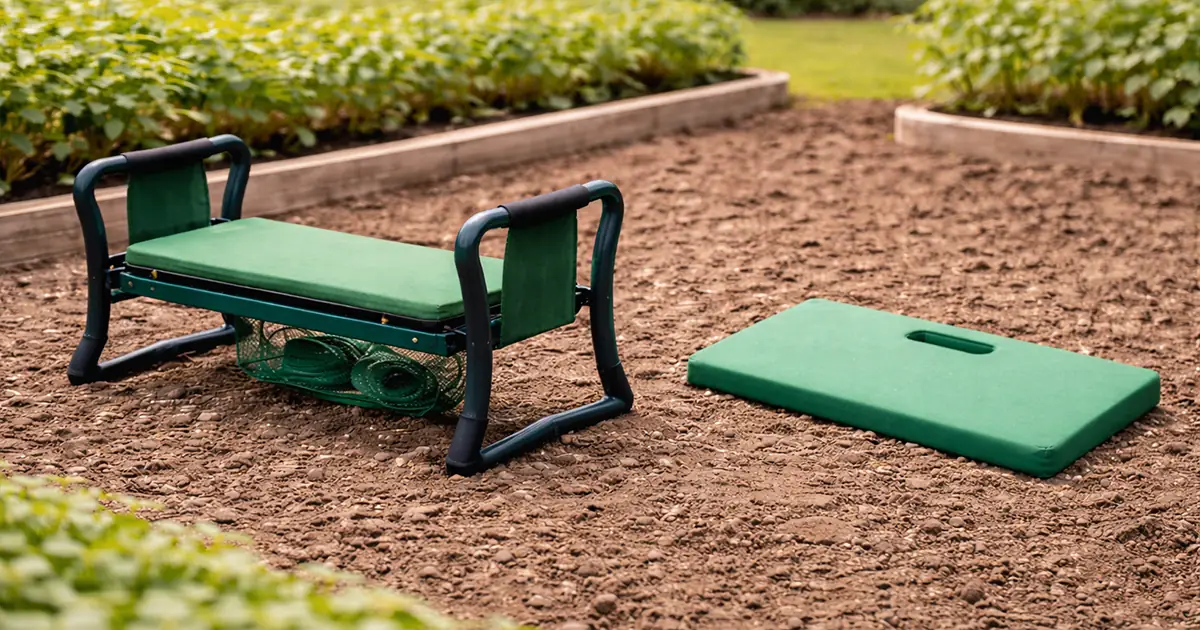
This guide covers garden kneeler vs kneeling pad — what to look for, which models perform best, and how to match the right option to your routine. A garden kneeler and a kneeling pad both reduce knee pressure, but they solve different constraints. One adds structure, handles, and often seat mode. The other stays minimal, light, and fast to move. People usually compare them by price first, then end up replacing the first purchase because the real issue was stand-up difficulty, session length, or storage size.
The practical decision is simple once you map product type to task pattern. If your sessions are long or getting back up is already difficult, a framed kneeler is usually the correct tool. If your sessions are short and you want maximum mobility, a pad may be enough.
Garden Kneeler Vs Kneeling Pad: What’s the Actual Difference?
Garden Kneeler — What It Is — Garden Kneeler Vs Kneeling Pad
A garden kneeler uses a metal frame with a padded top surface. In kneeler mode, you place your knees on the pad and use side handles for controlled stand-up support. Many models also flip into a low seat, so the same frame can be used for short seated tasks. The key difference is structure: the frame carries load, the handles change transition mechanics, and padding is fixed to a stable platform.
That fixed platform matters on uneven soil because the pad doesn’t twist or slide independently under knee pressure. In repeated use, this gives more predictable body alignment than loose foam pads.
Kneeling Pad — What It Is
A kneeling pad is a standalone foam or gel cushion with no frame and no handles. You place it on the ground, kneel, then move it as needed. It’s lightweight, compact, and easy to store in small spaces. The trade-off is mechanical support — a pad protects knees from surface pressure, but it doesn’t help with stand-up leverage and doesn’t provide seat function.
Pads also vary sharply by material quality. Two products can look similar online while one bottoms out in minutes and the other stays supportive for a full session.
Direct Comparison — The Numbers
| Factor | Garden Kneeler | Kneeling Pad |
|---|---|---|
| Price | $25–$70 | $10–$30 |
| Portability | Medium (folds) | Maximum (light, compact) |
| Knee protection | Good | Good (depends on thickness) |
| Stand-up support | Yes (handles) | No |
| Seat function | Some models | No |
| Durability | Medium–High | Low–Medium |
| Best for | Long sessions, sensitive knees | Short sessions, mobility |
If your main issue is surface cushioning and you move constantly, pad-first is efficient. If your issue includes repeated stand-up effort or longer sessions, kneeler-first is the better technical fit.
When a Garden Kneeler Is the Right Choice
Choose a garden kneeler when stand-up movement is part of the problem, not just knee contact pressure. If knee or back pain makes unassisted rising unreliable, handles are the deciding feature. A kneeling pad can’t provide that support because it has no rigid structure.
A kneeler is also the right tool for regular sessions above 30 minutes. In longer sessions, transition efficiency matters as much as padding comfort. With a framed kneeler, you get repeatable posture, stable leverage points, and less uncontrolled load during kneel-to-stand cycles. This is especially useful in tasks like weeding, planting starts, edging, and hand-level maintenance where you repeat short position changes constantly.
Pick a kneeler when you want seat-mode breaks in the same tool. Convertible models let you switch from kneeling to low seated work without walking away for a separate chair. For mixed workflows, this saves time and keeps movement predictable.
A kneeler also makes sense when you need consistent knee protection several times per week. Fixed-platform padding stays more stable under load than low-density pads that shift or compress quickly. If gardening is routine rather than occasional, the framed setup is usually the more durable long-term purchase.
When a Kneeling Pad Is Enough
A kneeling pad is enough when gardening is infrequent or sessions are short. For quick jobs — 5 to 15 minutes of weeding or potting touch-ups — a simple pad solves direct knee pressure without adding frame weight or setup steps.
Use a pad when you don’t need handle-assisted stand-up. If rising from kneeling is comfortable and controlled, the extra structure of a kneeler is unnecessary. In that case, portability becomes the priority, and pads are clearly better.
A pad is also the better fit when storage is tight and tools must stay compact. It can hang on a hook, slide into a tote, or move between garden and household tasks with no folding mechanism. For mobile routines and short-duration use, a quality thick pad is often all you need.
For typical light use, replacing a worn pad every season can still be cheaper than buying a low-quality kneeler that develops hinge play early.
What If You Need Both?
Owning both is practical for many gardens. Use a kneeling pad for fast, small-area tasks where carrying a frame would slow you down. Use a garden kneeler for longer sessions, repetitive transitions, or days when you need seated breaks between kneeling intervals.
This split setup avoids overusing one tool outside its strengths. You keep the speed of a pad for quick work and the support of a kneeler for demanding sessions. If your weekly routine includes both short touch-ups and longer maintenance blocks, a two-tool setup is usually the most efficient answer.
What Most Buyers Overlook
Cheap pads compress faster than expected. A $10 pad with about 1 inch of low-density foam can flatten quickly and lose pressure relief in regular use. A $20 pad with around 3 inches of quality EVA usually maintains support longer and feels more stable under repeated kneeling. Thickness and foam density are more predictive than price alone.
Kneeler folding size varies more than listings suggest. Some models fold to compact dimensions around 15″x9″, while others remain bulky and awkward in narrow storage spaces. If your shed, balcony box, or utility shelf is limited, check folded dimensions before ordering. A good kneeler that doesn’t fit your storage routine tends to get used less consistently.
Our Recommendation
- If you garden for 30+ minutes at a time or standing up is already difficult, go with a garden kneeler. Models like Ohuhu or KVR give handles and stable support that a pad can’t provide. See best garden kneeler and seat for specific picks.
- If your sessions are short and mobility is the priority, go with a kneeling pad. Gorilla Grip Thick Foam and NoCry Gel are solid reference points for portable cushioning. See best kneeling pads for the shortlist.
- If you want the full decision framework before buying, use the complete category guide: garden kneeler buying guide.
For gardening equipment guidance, see the Royal Horticultural Society.