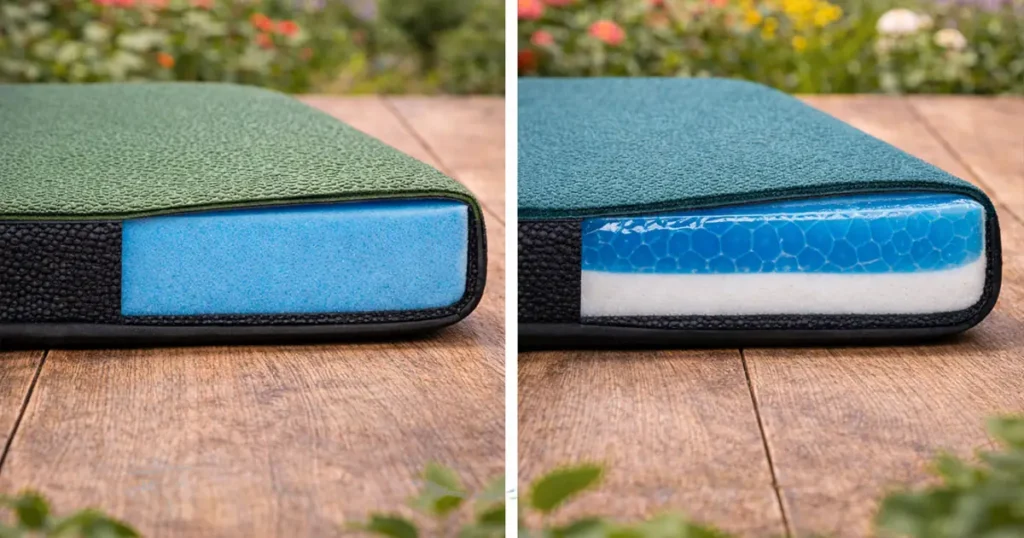
This guide covers foam vs gel kneeling pad — what to look for, which models perform best, and how to match the right option to your routine. Foam versus gel appears in both ground kneeling pads and wearable knee pads. The useful choice depends on session length, surface hardness, and how quickly compression reduces effective cushioning.
Short sessions on soft soil can make both materials feel similar. Longer sessions on hard contact surfaces usually expose differences in pressure distribution and recovery behavior.
This comparison focuses on material behavior under load, not marketing comfort claims.
Foam Vs Gel Kneeling Pad: How Foam Kneeling Pads Work
Foam pads in this category usually use EVA or high-density polyethylene variants. Under load, foam compresses and spreads force across a larger area. Recovery speed depends on density and cell structure. Higher-density foam rebounds more consistently and resists permanent set better than low-density alternatives.
Foam advantages include lower cost, lower weight, and stable behavior across a wide temperature range. Foam limits include faster compression fatigue in heavy repeated use, especially on hard surfaces.
Price range is usually lower than gel designs, with broad availability across budget and mid tiers. Foam behavior also changes with thickness and layering. Thick low-density foam can still underperform thinner high-density foam in long sessions. Buyers should interpret thickness claims together with long-term compression feedback.
How Gel Insert Pads Work
Gel systems distribute load through a semi-fluid insert layer that deforms under pressure and reduces peak point loading. In sustained kneeling blocks, gel can maintain contact comfort longer than thin foam.
Gel inserts often sit above or within foam support layers. Durability depends on insert quality and bonding with surrounding materials. Repeated compression can still degrade performance over time, especially in low-cost gel blends.
Gel products usually cost more than foam-only pads and weigh more in similar dimensions. In wearable pads, gel can improve pressure spread during prolonged crouch-kneel cycles, but strap stability still determines whether that benefit remains aligned with the knee over time.
Side-by-Side Comparison
| Attribute | Foam | Gel |
|---|---|---|
| Price Range | Lower | Higher |
| Compression Duration | Moderate to fast, density-dependent | Slower pressure buildup in long sessions |
| Recovery Speed | Usually fast with quality foam | Moderate, depends on insert and temperature |
| Weight | Lower | Higher |
| Cold Weather Performance | Generally stable | Can stiffen in cold conditions |
| Typical Lifespan | Good with dense foam, declines with low-density cores | Good in quality systems, variable in budget gel |
When Foam Is the Right Choice
Foam is usually the better choice for short-to-medium sessions, mobile use, and budget-sensitive buying. It is lighter, simpler, and often more consistent in cold weather.
Dense foam is especially practical when sessions are intermittent and the pad has recovery time between uses. For mixed terrain and frequent repositioning, lower weight can matter as much as cushioning depth.
Foam is also easier to source across many sizes and formats. This matters for buyers who need quick replacement cycles.
When Gel Is the Right Choice
Gel is usually the better choice for longer sessions on hard or compact surfaces where pressure peaks become the limiting factor. It can maintain comfort consistency better in sustained contact blocks.
Gel also suits users who tolerate extra weight in exchange for slower pressure buildup. This is common in static kneeling workflows with limited movement.
Higher-quality gel systems can perform very well for heavier users when session duration is long and contact load remains high.
What Most Buyers Overlook
Gel can harden in cold weather, reducing initial comfort until material warms during use. Foam behavior is generally more stable at low temperatures.
Foam recovery needs time. Repeated sessions with little recovery interval can accelerate compression fatigue, especially in lower-density materials.
Gel does not always beat dense foam in short sessions. In many 10–20 minute tasks on soft ground, quality foam performs similarly with lower weight and lower cost. Pad shell construction also matters. A high-quality insert can underperform if the shell allows uneven pressure channels or early abrasion at high-contact zones. Wearable applications add another variable: strap migration. If the pad rotates or slides, material advantages become less relevant because pressure is no longer distributed where needed.
Realistic Expectations
Neither material is permanent under repeated load. Both compress over time, and both lose performance faster on hard surfaces.
Material choice should match work pattern. Foam is often sufficient for mobile short sessions. Gel is often better for longer hard-surface blocks.
The practical objective is minimizing pressure spikes in the actual use environment, not buying the highest material label. For many gardeners, mixed-tool setups are optimal. Dense foam for mobile tasks and gel for static hard-surface tasks can outperform one-material-only strategies. Replacement timing should be expected, not viewed as product failure. Both materials are consumable in repetitive kneeling workflows. Buyers who track session length and surface exposure usually make better replacement decisions than buyers relying on visible wear alone.
Quick Decision Guide
- Short sessions and frequent movement → dense foam is usually sufficient
- Long sessions on hard surfaces → gel insert usually performs better
- Cold-weather routine → foam usually behaves more consistently
- Budget-sensitive buying → foam options generally provide better value density
- Full framework → garden kneeler buying guide
- Ground pad shortlist → best garden kneeling pads
- Wearable pad shortlist → best garden knee pads
For joint protection guidance, see the Arthritis Foundation.