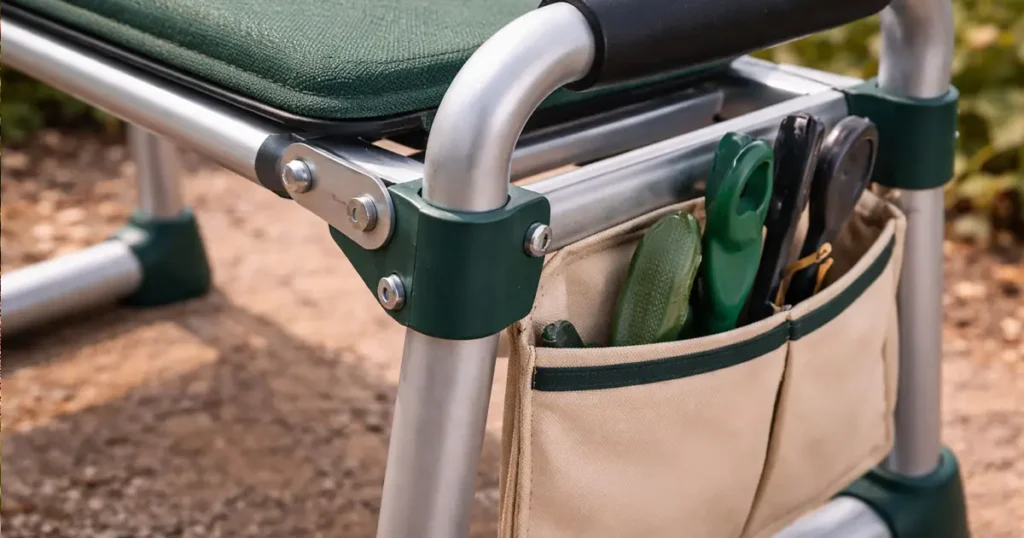
This guide covers garden kneeler weight capacity — what to look for, which models perform best, and how to match the right option to your routine. Weight capacity is listed on nearly every garden kneeler, but the number is rarely explained. Many buyers assume it reflects all real use conditions equally. That assumption causes avoidable purchasing errors.
Most ratings are based on controlled static loading. Real gardening includes dynamic movement, asymmetric push-off, and variable terrain contact. Those conditions can change how a frame feels even below the listed limit.
This guide explains what the numbers usually mean and how to use them for better selection.
Garden Kneeler Weight Capacity: How Capacity Ratings Work
Static load testing applies force under controlled conditions in a fixed orientation. Dynamic use adds movement, shifting force paths, and short peak loads during transitions.
Stand-up movement usually produces higher localized stress than static kneeling because one side often loads first. That asymmetry increases hinge and rail demand temporarily.
Rated capacity should therefore be treated as a structural threshold indicator, not a full comfort or stability guarantee under all movements. Manufacturers also differ in rating conservatism, and that detail is rarely disclosed in product listings.
Capacity Tiers in This Category
Budget tier usually spans about 200–250 lbs. Mid-tier commonly spans 300–330 lbs. Premium and heavy-duty models often span 330–400 lbs.
The tiers are not only labels. They usually reflect changes in frame gauge, weld quality, and hinge design. Higher tiers generally maintain alignment and confidence longer under repeated dynamic use.
Capacity labels alone do not capture all quality variables, but they are useful first filters. Tier movement also affects expected wear timeline. Higher tiers usually preserve transition feel longer in frequent-use routines. Tier differences also influence confidence at the same body weight. A 240-lb user on a 250-lb budget frame may experience noticeable flex and reduced confidence, while the same user on a 330-lb frame often reports more stable transitions even at similar session length.
Why Capacity Margin Matters
A practical margin rule is selecting a kneeler rated at least 50 lbs above body weight when stand-up support is important. This margin improves confidence and reduces near-limit stress accumulation.
Near-limit usage often increases perceived flex and can accelerate long-term wear at hinges and welds. Even without immediate failure, movement quality can degrade sooner.
For users with joint sensitivity, stable controlled transitions are part of safety. Capacity margin supports that control. Margin is especially important on uneven terrain where one leg can sink and amplify side loading.
Frame Material and Capacity
Steel and aluminum ratings should not be compared at face value without geometry context. Cross-section size, wall thickness, and joint architecture all affect real load distribution.
A robust aluminum design can outperform weak steel geometry. A thick-wall steel frame can outperform thin aluminum under high asymmetric load.
Capacity interpretation should combine material class, frame geometry, and user reports about flex behavior. Handle anchoring and weld placement should be reviewed because these points carry high stress in real stand-up movement. Closed-loop frame shapes and wider base geometry can also improve how load is distributed into the ground. This is why two kneelers with equal rating labels may feel very different in real gardens.
What Most Buyers Overlook
Capacity rating does not describe hinge longevity. Two models with the same rating can diverge after months of fold cycles.
Terrain changes effective behavior. Soft or uneven contact can amplify side loading, making a frame feel less stable than static tests suggest.
Review timing matters. First-week ratings rarely capture near-limit behavior over repeated transitions. Body mechanics also change effective demand. Fast rotational rises generally stress frames more than slow controlled rises. A fourth blind spot is shared-use households. A kneeler used by multiple users at different body weights and movement styles accumulates higher total stress cycles than a single-user tool. Capacity and hinge durability should be sized for the heaviest regular user and the most demanding transition style.
Realistic Expectations
Capacity numbers are necessary but incomplete. Buyers should treat them as baseline filters, then evaluate frame behavior and long-term use feedback.
Higher-capacity tiers usually improve confidence for heavier users and frequent transition routines. No rating removes the need for proper setup and controlled movement. A model can remain below rated limit and still feel unsuitable if flex and wobble increase beyond user comfort. Most users will notice behavior changes before outright failure. Increased handle movement, hinge noise, and less precise lock engagement are early indicators that the frame is approaching functional limits for the current workload.
The useful expectation is progressive performance change, not sudden breakage. Capacity-aware buyers can replace or upgrade before stability drops to an unacceptable level.
Quick Decision Guide
- Body weight near 230 lbs and above → prioritize mid-tier or heavy-duty capacity ranges
- Stand-up support is critical → choose at least 50 lbs above body weight
- Uneven terrain is common → prioritize rigidity feedback, not label alone
- Comparing steel and aluminum → evaluate geometry and user-reported flex together
- Full framework → garden kneeler buying guide
- Material context → steel vs aluminum garden kneeler frames
- Heavy-user shortlist → best garden kneelers for heavy people
For general gardening equipment advice, see the Royal Horticultural Society.