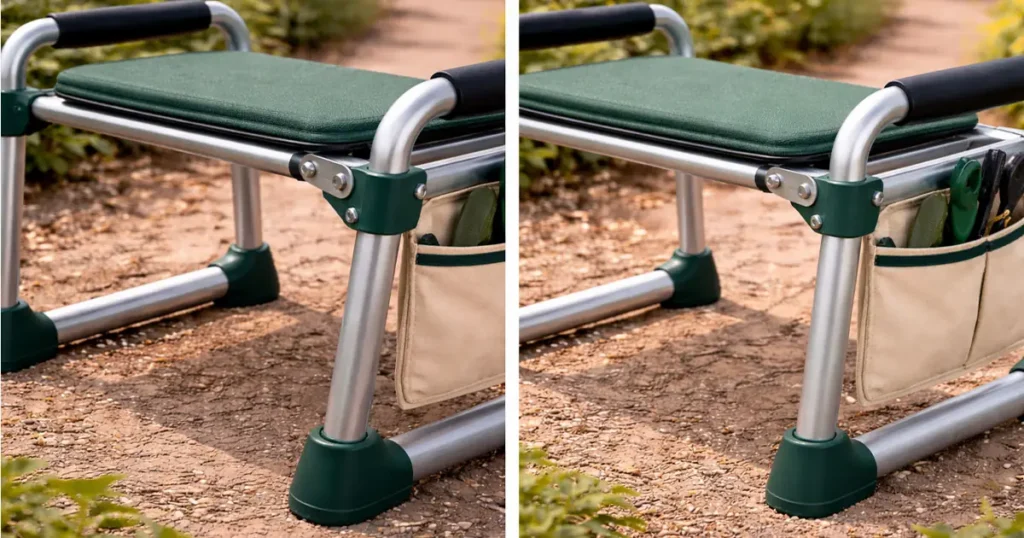
This guide covers garden kneeler materials steel aluminum — what to look for, which models perform best, and how to match the right option to your routine. Three frame material groups dominate this category: steel, aluminum, and plastic or composite structures. Each group trades weight, rigidity, corrosion behavior, and cost differently.
The right choice depends on body weight, storage conditions, transport frequency, and terrain pattern. Material choice is a performance decision, not only a price decision.
Garden Kneeler Materials Steel Aluminum: Steel Frames
Steel frames are generally heavier and often feel more planted under asymmetric push-off. In many models, steel also supports higher capacity ranges through thicker wall sections and stronger joint behavior.
Corrosion is the main risk. Steel relies on coating quality and storage discipline. Poor coating and persistent moisture can accelerate surface rust, especially near joints.
Cost is usually lower than aluminum at comparable geometry, which makes steel dominant in budget and mid tiers. Steel is typically best for buyers prioritizing stability and value. Steel also tends to tolerate dynamic push-off better in lower-cost designs because wall thickness can remain practical without premium pricing. This is why many heavy-user recommendations still cluster around steel frames. Steel can also be repaired or repainted more easily in some long-term ownership scenarios, which adds practical value for users comfortable with maintenance.
Aluminum Frames
Aluminum frames usually reduce carry weight versus steel, which improves handling in multi-zone routines. This is especially useful for users who move kneelers often.
Corrosion tolerance is generally better because aluminum does not rust like steel. However, rigidity can vary with wall thickness and section design. Thin aluminum can feel less planted under hard asymmetric loading.
Aluminum usually costs more and appears more often in mid-to-premium tiers. It is best for portability-priority users with moderate load requirements. In damp climates, aluminum often reduces maintenance burden because rust management is less demanding. This can be a meaningful ownership difference over multiple seasons. For users transporting kneelers to allotments or shared gardens, this lower weight can reduce daily carry friction enough to improve consistency of use.
Plastic and Composite Frames
Plastic and composite frames appear mostly in lighter-duty products and seat-oriented designs. Advantages include low corrosion risk and simple low-cost manufacturing.
Limits include lower rigidity and lower typical capacity ceilings in many models. Under higher dynamic loading, these frames often provide less confidence than metal structures.
They are usually appropriate for light occasional routines and inappropriate for heavy users needing strong transition support. Composite options can still be useful in secondary roles, such as backup kneelers in one fixed garden zone where loads are low and mobility needs are limited. Where impact exposure is low and environmental moisture is high, composite options may offer acceptable lifespan with minimal corrosion concerns.
Side-by-Side Material Comparison
| Attribute | Steel | Aluminum | Plastic/Composite |
|---|---|---|---|
| Frame Weight | Higher | Lower | Lowest to low-moderate |
| Rigidity | Usually high at similar geometry | Moderate to high, design-dependent | Low to moderate |
| Corrosion Risk | Higher without strong coating | Low rust risk | Very low corrosion concern |
| Typical Max Capacity | Often highest tier ranges | Moderate to high | Usually lower |
| Cost Range | Budget to mid | Mid to premium | Budget to mid |
| Best For | Stability and load margin | Portability and wet storage tolerance | Light-duty occasional use |
Foam and Padding Materials
Frame material and pad material should be evaluated together. EVA foam is common because it balances durability, recovery, and cost. Polyethylene variants can vary in firmness and retention depending on density. Gel inserts can improve sustained pressure distribution but usually add cost and weight.
Surface type drives wear rate. Hard surfaces accelerate compression for all foam systems. Replacement pad availability should be checked in high-use routines, especially where hardscape contact is frequent. Foam chemistry also changes feel under temperature variation. Some foams stiffen in cold weather and recover slowly after compression, while denser systems maintain more stable support in fluctuating conditions. Pad attachment method matters too. Bonded pads and mechanically secured pads age differently. Delamination is more common where adhesive quality is weak or moisture enters repeatedly. Replacement availability should be treated as a buying spec in high-use cases. A frame with replaceable pads can extend practical tool life substantially compared with bonded designs that require full replacement.
What Most Buyers Overlook
Coating quality on steel can matter more than steel versus aluminum in damp environments. A strong powder coat can outperform weak painted alternatives regardless of base material.
Plastic-frame options are often compared by weight only. For users relying on stand-up leverage, rigidity behavior is usually more important than absolute mass.
Material labels also hide geometry variation. Cross-section and wall thickness often explain performance differences better than material name alone. A practical review method is comparing user comments on flex and wobble after six months rather than launch-week impressions. Long-term movement behavior is where material and geometry choices become visible.
Realistic Expectations
No material is universally best. Steel usually leads on value and rigidity. Aluminum usually leads on transport ease and corrosion tolerance. Plastic and composites usually lead on low cost and simplicity with lower load margins.
Correct selection is use-pattern matching. Material choice should follow actual workload, not generalized ranking. Buyers who match material to terrain and session frequency usually report fewer replacement cycles and better consistency over time. The practical target is not finding a perfect material. It is choosing the least costly compromise for the actual demands of the garden routine.
Quick Decision Guide
- Stability and higher capacity are top priorities → steel is usually the practical first choice
- Frequent carrying and wet storage are top priorities → aluminum is usually better
- Light occasional use with low load demand → plastic or composite can be sufficient
- Frequent hard-surface use → prioritize foam quality regardless of frame material
- Full framework → garden kneeler buying guide
- Material deep dive → steel vs aluminum garden kneeler frames
- Capacity context → garden kneeler weight capacity
For more on garden tool materials, see the Royal Horticultural Society.