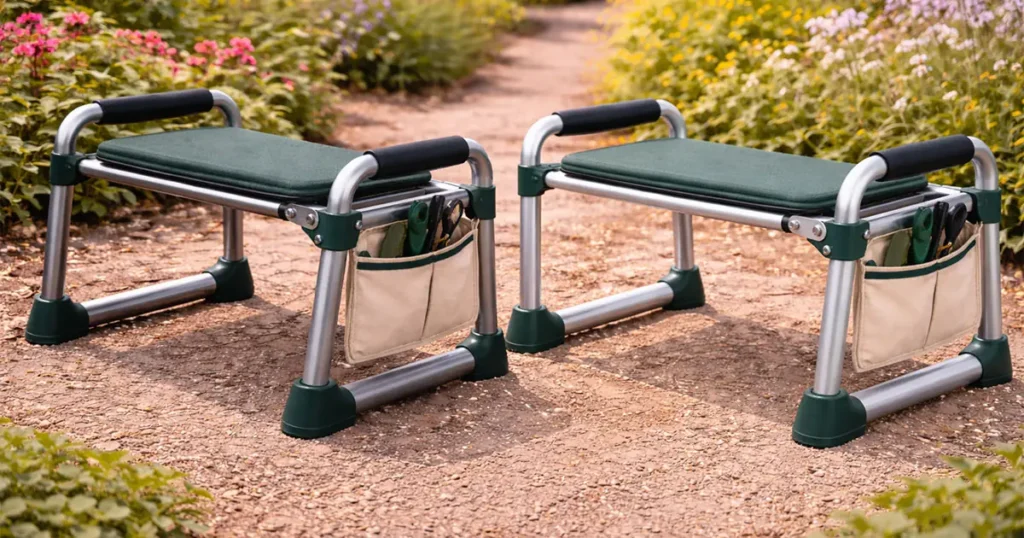
This guide covers wolf garten vs radius garden kneeler — what to look for, which models perform best, and how to match the right option to your routine. Wolf Garten and Radius Garden are often compared by buyers who want a durable kneeler with better-than-budget construction. Both brands are positioned above entry-level options, but they solve the problem differently. Wolf Garten generally emphasizes straightforward durability, predictable frame behavior, and simpler construction choices. Radius Garden generally emphasizes ergonomic form, comfort geometry, and user feel.
Neither approach is universally better. The better fit depends on which limitations show up first in regular use: frame flex under push-off, foam compression over long kneeling blocks, or handle leverage comfort during transitions. This comparison focuses on frame behavior, cushioning profile, handle geometry, and daily-use fit.
The goal is a practical decision. Buyers should choose the design philosophy that aligns with workload, terrain, and movement pattern.
Wolf Garten Vs Radius Garden Kneeler: What Makes Wolf Garten Distinctive
Wolf Garten kneeler designs are usually identified by robust frame behavior and practical simplicity. Frame construction tends to prioritize stiffness and predictable support rather than lowest possible carry weight. In real use, that often translates into solid push-off feel during stand-up transitions, particularly on firm soil and mixed hardscape edges.
Handle geometry is generally conventional but stable. The rails are designed to provide direct support during descent and rise without complex contouring. For buyers who value mechanical consistency over ergonomic nuance, this approach is often effective.
Cushioning systems in Wolf Garten style products typically rely on practical foam support tuned for repeated use rather than maximal softness. This usually means comfort remains acceptable over longer ownership periods, but the initial feel may be firmer than comfort-oriented alternatives.
Weight and capacity ranges vary by model, but the design trend is moderate-to-solid frame mass and practical load margin. This profile favors stability-first users who want predictable behavior more than minimal carry burden.
What Makes Radius Garden Distinctive
Radius Garden products usually center on ergonomic geometry. Handle angle, frame profile, and user contact points are often shaped to reduce awkward motion paths during kneeling and rise transitions. The design language favors comfort and body mechanics over simple straight-line frame architecture.
Materials and frame profile choices in Radius models often prioritize user feel and movement smoothness. Depending on model, this can improve perceived comfort during repetitive transitions, especially for users sensitive to posture angle and leverage path.
Cushioning behavior in Radius-oriented designs often aims for comfort distribution rather than pure firmness. Some buyers report better early-session pressure control, while long-term behavior still depends on foam density and terrain exposure like any kneeler system.
Capacity ranges are typically suitable for mainstream users, but model-by-model differences matter. Radius is often selected by buyers prioritizing ergonomic interaction and comfort profile over maximum structural headroom.
Side-by-Side Comparison
| Attribute | Wolf Garten | Radius Garden |
|---|---|---|
| Frame Material | Usually durability-first metal framing | Comfort-focused frame geometry with model variation |
| Weight | Moderate to heavier in stability-oriented models | Moderate, often tuned for balanced handling |
| Capacity | Practical mainstream-to-strong ranges by model | Practical mainstream ranges by model |
| Cushioning Type | Firm practical foam profile | Comfort-oriented foam profile in many models |
| Handle Geometry | Conventional, direct leverage layout | Ergonomic contour emphasis |
| Price Range | Mid to upper-mid depending on model | Mid to upper-mid depending on model |
| Best For | Buyers prioritizing structural predictability | Buyers prioritizing ergonomic movement feel |
Who Should Choose Wolf Garten
Wolf Garten is usually the better fit for buyers who prioritize frame behavior under repeated load and want fewer design variables. Users who value a stable, straightforward support feel during stand-up transitions often prefer this profile.
It is also a practical choice for buyers who work on mixed terrain and want predictable response under asymmetric push-off. In these scenarios, simple rigid geometry can feel more dependable than comfort-shaped alternatives.
Buyers prioritizing long-term structural consistency over contour-driven ergonomics usually align better with Wolf Garten design philosophy.
Who Should Choose Radius Garden
Radius Garden is usually the better fit for buyers who prioritize ergonomic interaction and movement comfort. Users sensitive to handle angle, posture path, and transition feel often prefer this profile.
It can also be a strong choice for gardeners doing repetitive moderate-duration sessions where comfort geometry affects fatigue accumulation more than absolute frame mass.
Buyers who value how the tool feels during movement, not only how rigid it feels under load, often align better with Radius Garden designs.
What Most Buyers Overlook
Most comparisons overemphasize first-use comfort and underweight long-horizon behavior. Foam compression, hinge tolerance change, and rail stability divergence typically appear after several months. Early review impressions often miss this.
Another overlooked factor is terrain profile. A kneeler that feels ideal on level soft soil may behave differently on hard edges and uneven contact points. Buyers should interpret feedback from users with similar terrain conditions.
The final blind spot is expectation mismatch. Some buyers expect ergonomic geometry to improve all outcomes. In practice, ergonomics improve movement feel, but they do not replace structural margin in heavy-use conditions.
Realistic Expectations
Both brands can perform well in normal home-garden routines when model fit and use pattern align. Neither brand eliminates foam wear, hinge fatigue, or terrain-driven variability. Differences are real, but they appear in specific use conditions rather than every minute of every session.
Wolf Garten usually favors stability-first predictability. Radius usually favors ergonomic movement quality. Buyers should expect trade-offs either way.
The practical expectation is better fit, not perfect performance. Matching design profile to daily workflow is more important than buying by brand reputation alone.
Quick Decision Guide
- Priority is rigid push-off stability and straightforward frame behavior → Wolf Garten
- Priority is ergonomic handle feel and movement comfort → Radius Garden
- Mixed terrain and heavier loading concern → lean toward stability-first Wolf profile
- Moderate loads with posture-sensitive use → lean toward ergonomic Radius profile
- Full framework → garden kneeler buying guide
- Material context → steel vs aluminum garden kneeler frames
- Broader shortlist → best garden kneelers
For garden tool guidance, see the Royal Horticultural Society.