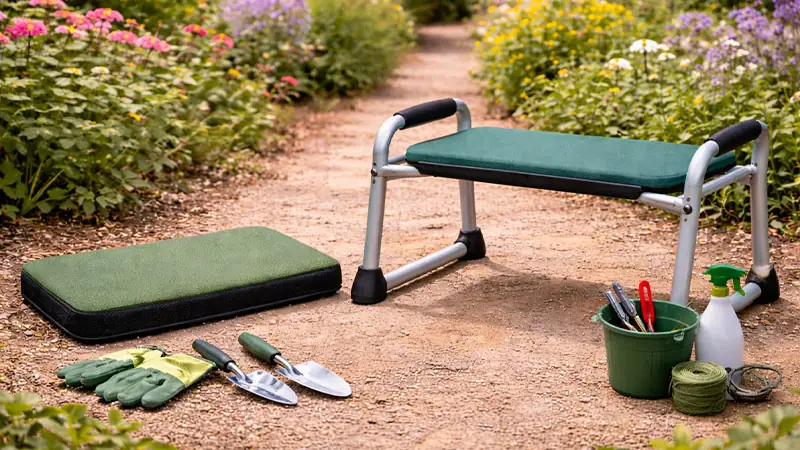
This guide covers garden kneeler vs garden stool — what to look for, which models perform best, and how to match the right option to your routine. These products solve different mechanical problems. A kneeler supports controlled descent and rise from kneeling. A stool eliminates kneeling and keeps work in a seated low-height posture.
Neither option is universally better. The better choice depends on task type, terrain, and physical limitation profile.
This comparison resolves the decision by use pattern rather than by feature count.
Garden Kneeler Vs Garden Stool: What a Garden Kneeler Does Well
A handled kneeler improves transition leverage during rise and descent. This is valuable for users who can still kneel but need support in movement phases.
Kneeler padding reduces direct contact pressure and works well for close ground-level tasks. Most models also offer convertible seat mode, adding short seated intervals without carrying a separate stool.
Kneelers also handle uneven ground better than many stools because frame rails provide wider support geometry. For tasks that demand frequent repositioning, kneelers also preserve close-access precision. Users can shift inches at a time without re-establishing full seated setup.
What a Garden Stool Does Well
A stool eliminates kneeling load entirely for reachable tasks. This can reduce cumulative knee stress in users who cannot tolerate kneeling positions.
For extended pruning, sorting, or low-reach maintenance, stool posture can be more sustainable than repeated kneel-stand cycles. A stable stool also provides predictable work height.
Stools can be more intuitive for users who prefer static work blocks rather than frequent transitions. Some stool designs also improve tool organization because users can keep supplies in a fixed seated zone instead of carrying tools between kneeling points.
Where Each Falls Short
Kneeler limits: no advantage when kneeling itself is not tolerable. If the user cannot kneel comfortably even with support, kneeler benefits shrink.
Stool limits: no kneeling cushioning for close soil-level tasks. Stability can also drop on uneven ground, depending on leg geometry and surface conditions.
Low stool height can become a second limitation for users with restricted hip range. Rolling stool variants add another limit in loose terrain. Wheels can bind or drift, reducing control and increasing repositioning effort.
Side-by-Side Comparison
| Feature | Garden Kneeler | Garden Stool |
|---|---|---|
| Knee Loading | Reduced during kneeling | Eliminated for seated tasks |
| Rise Support | Strong with handles | Depends on stool height and arm support |
| Stability on Uneven Ground | Usually good with wide frame | Variable, often lower on rough terrain |
| Portability | Foldable options common | Compact in simple models, bulky in rolling models |
| Price Range | Broad, budget to premium | Broad, often similar to kneeler tier |
| Best Use Case | Mixed kneeling + transition support | Kneeling avoidance and extended seated work |
Who Should Choose a Kneeler
Users who can still kneel and need better transition control should choose kneelers. This includes users with moderate joint limitations and workflows requiring close ground access.
Kneelers also fit mixed routines where users alternate kneeling and short seated breaks.
They are usually the better choice when terrain is uneven and repositioning is frequent. Users working in dense planting beds often benefit from kneeler flexibility because seat legs can restrict access in narrow spacing.
Who Should Choose a Stool
Users who need to avoid kneeling entirely should choose stools. This includes users with severe kneeling intolerance or workflows centered on seated low-height tasks.
Stools are also practical for longer continuous tasks where posture stability matters more than reach variability.
On flat firm surfaces, stools can sustain longer low-height work with fewer transitions. Users who prioritize predictable rhythm over maximum reach usually report better consistency with stool-first setups.
What Most Buyers Overlook
Convertible kneelers can function as a middle ground, but seat height is usually low and not equivalent to dedicated stool ergonomics.
Stool height can also become a limitation. Users with reduced hip flexion may still struggle with very low stool transitions.
Many buyers eventually use both tools by task category, not by one-time preference. A second overlooked issue is path interference. Stool legs and wheel bases can conflict with dense planting layouts, while kneeler rails can interrupt long seated pruning patterns.
Realistic Expectations
Both tools reduce different loads and introduce different constraints. A kneeler supports transitions and ground access. A stool reduces kneeling demand but can reduce reach flexibility.
No single format solves every low-height task efficiently. Matching tool type to work pattern is more effective than forcing one format into all scenarios. Many high-frequency gardeners eventually assign tools by task block, not by product preference. Kneeler for close soil work, stool for prolonged seated work, and switch points planned in advance. This hybrid strategy usually reduces cumulative fatigue because each tool is used where its mechanics are strongest.
Quick Decision Guide
- Need rise support with continued kneeling → choose kneeler
- Need to avoid kneeling entirely → choose stool
- Mixed routine with variable tasks → consider convertible kneeler first
- Long seated low-reach tasks → stool usually performs better
- Full framework → garden kneeler buying guide
- Convertible shortlist → best convertible garden kneeler seats
- Related comparison → garden kneeler vs garden seat
For gardening equipment guidance, see the Royal Horticultural Society.