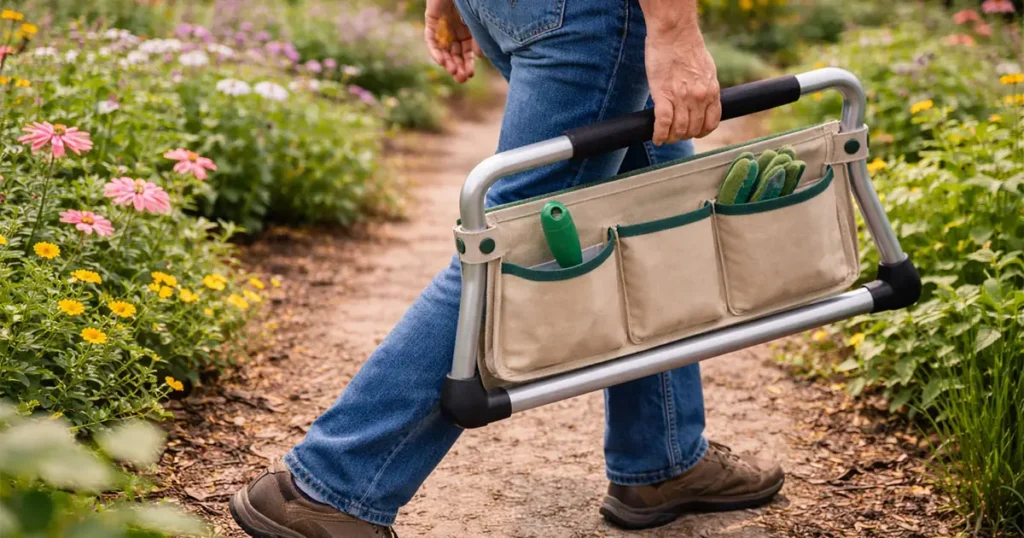
This guide covers best lightweight garden kneelers — what to look for, which models perform best, and how to match the right option to your routine. Standard handled kneelers usually weigh about 1.2–2.8 kg. That spread looks small in listings and large in daily use. Repeated carrying between beds, paths, and storage zones adds measurable fatigue over a session.
Lightweight design is therefore functional, not cosmetic. Lower mass improves transport and repositioning convenience, especially for older gardeners and users with limited arm strength. The trade-off is structural: lighter frames often use thinner materials, lower foam depth, or simplified hardware.
This guide compares lightweight options by actual carry impact, frame material behavior, and capacity limits.
Best Lightweight Garden Kneelers: What Lightweight Actually Means in This Category
In practical terms, lightweight handled kneelers usually sit near the low end of the standard range, often around 1.2–1.8 kg. Mid-weight handled models often sit around 1.9–2.4 kg. Heavier stability-focused models can exceed that range.
Aluminum usually lowers weight versus steel at comparable geometry, but this does not guarantee better performance in every use case. Lower mass improves portability and can reduce planted feel under aggressive push-off.
Material reduction often appears in thinner wall sections, smaller cross-members, and lighter hinge assemblies. Buyers should evaluate where those reductions are acceptable in their routine. Carry profile should be assessed with total load, not kneeler weight alone. Gloves, hand tools, and water containers amplify handling fatigue, so a one-kilogram difference can become meaningful over repeated trips. For transport-heavy routines, folded balance and grip placement are often as important as measured mass.
Our Top Picks at a Glance
| Product | Weight | Frame Material | Capacity | Trade-Off |
|---|---|---|---|---|
| Fiskars Ultralight Kneeler | ~2.6 lbs | Aluminum | 300 lbs | Higher price than standard steel options |
| SONGMICS Garden Kneeler and Seat | ~2.5 lbs | Steel (light-gauge) | 330 lbs | Less planted feel than heavier frames |
| KVR Garden Kneeler and Seat | Mid-light class | Steel | 330 lbs | Heavier than ultralight options |
| Ohuhu Garden Kneeler and Seat | Mid-light class | Steel | 330 lbs | Carry weight higher than true ultralight models |
Best Overall Lightweight — Fiskars Ultralight Kneeler
What It Does Well — Best Lightweight Garden Kneelers
Fiskars combines low carry mass with stable everyday behavior and corrosion-resistant frame material.
Where It Falls Short
Price premium is the main barrier in value-sensitive buying.
Who Should Buy This
Users moving kneelers often across multiple zones.
Best for Elderly — SONGMICS Garden Kneeler and Seat
What It Does Well
Low carry weight and simple folding improve day-to-day handling for users prioritizing lower lift demand.
Where It Falls Short
Frame rigidity is moderate, not heavy-duty.
Who Should Buy This
Older users with light-to-moderate workloads and frequent repositioning.
Best for Transport or Allotment — KVR Garden Kneeler and Seat
What It Does Well
Balanced frame behavior and fold profile support transport use where reliability and portability both matter.
Where It Falls Short
Not the lightest option in this category.
Who Should Buy This
Users carrying tools to external plots who need balanced performance.
Best Balance of Light + Stable — Ohuhu Garden Kneeler and Seat
What It Does Well
Ohuhu offers strong stability relative to weight and broad long-term review history.
Where It Falls Short
Carry load is moderate rather than minimal.
Who Should Buy This
Users wanting dependable structure with manageable transport burden.
What Most Buyers Overlook
Low scale weight does not always mean lower carry effort. Folded shape, grip points, and balance during one-hand carry matter equally.
Capacity margins still matter in lightweight models. Lower mass does not remove dynamic stand-up forces. Users near rating limits should prioritize structural margin over minimum weight.
Hinge quality is the third blind spot. Lightweight frames with weak hinge tolerance can feel unstable sooner than expected. A fourth blind spot is terrain mismatch. Lightweight frames can perform well on firm soil and feel unstable on very soft ground where legs sink unevenly. Buyers should evaluate likely ground conditions before prioritizing minimum weight. Another overlooked factor is handle diameter. Very thin handles can reduce grip confidence in damp conditions, especially for users with lower hand strength.
Realistic Expectations
Lighter frames improve portability, but they often reduce reserve rigidity compared with heavier heavy-duty designs. This is an expected engineering trade.
For regular home use, lightweight models can perform well when capacity and terrain match the design envelope. For heavy daily use on hard uneven surfaces, wear progression is usually faster. Users expecting heavy-duty behavior from ultralight frames usually report disappointment. The better expectation is easier transport with adequate, not maximum, structural reserve. Durability can still be good when workload is matched. Many lightweight units remain effective for multiple seasons in moderate-use gardens with covered storage and mixed soft surfaces. Planned maintenance improves outcomes in this category. Simple hinge cleaning and dry storage reduce early play and preserve stability feel over longer intervals.
Quick Decision Guide
- Carry fatigue is the main problem → prioritize lowest practical weight with stable handles
- Elderly or reduced arm strength → choose lighter foldable model with simple grip geometry
- Allotment transport use → choose compact folded profile and moderate weight balance
- Near capacity limits → prioritize capacity margin before minimum weight
- Full framework → garden kneeler buying guide
- Elderly-focused options → best garden kneelers for elderly
- Fold behavior detail → folding vs fixed garden kneelers
For gardening equipment guidance, see the Royal Horticultural Society.